
The Case
The practical casefor self‑governance.
Self-determination is the defining question of the century: who holds the right to govern, and by whose consent. Texas is where that question gets decided first. What follows treats it as a serious question and answers every objection you are about to raise. The door is not locked. It never was.
The argument
Three things are true at once.
The case for self-governance rests on a principle, a fact, and a judgment, each standing on its own. None of it requires anger.
Government rests on consent.
The American founding rests on a single premise: that governments derive their just powers from the consent of the governed. Self-determination is that same premise, stated plainly, not a fringe idea grafted onto it after the fact.
A people who no longer consent to how they are governed are not obligated to pretend otherwise. The real question is how they reconsider lawfully, by process and by vote.
Texas is capable of it.
Texas is the eighth-largest economy on Earth, a $2.77 trillion engine larger than Italy, Canada, or Russia, with its own ports, power grid, energy production, and the number one export economy in the United States for 23 years running. This is not a small territory imagining a future it cannot sustain.
The question of capability was answered long ago by the sheer scale of the place. Nations a fraction of its size govern themselves without controversy. Given all of that, the honest question is who else could, if a state with these numbers could not.
The current arrangement is failing.
Texas could govern itself, and the federal arrangement is no longer delivering what a government owes the governed: a secure border, a solvent balance sheet, and decisions made close to the people they affect.
When the distance between the governed and the governing grows too wide, self-government becomes a remedy, not merely a grievance. That is the judgment on offer, and it is one a free people are entitled to make.
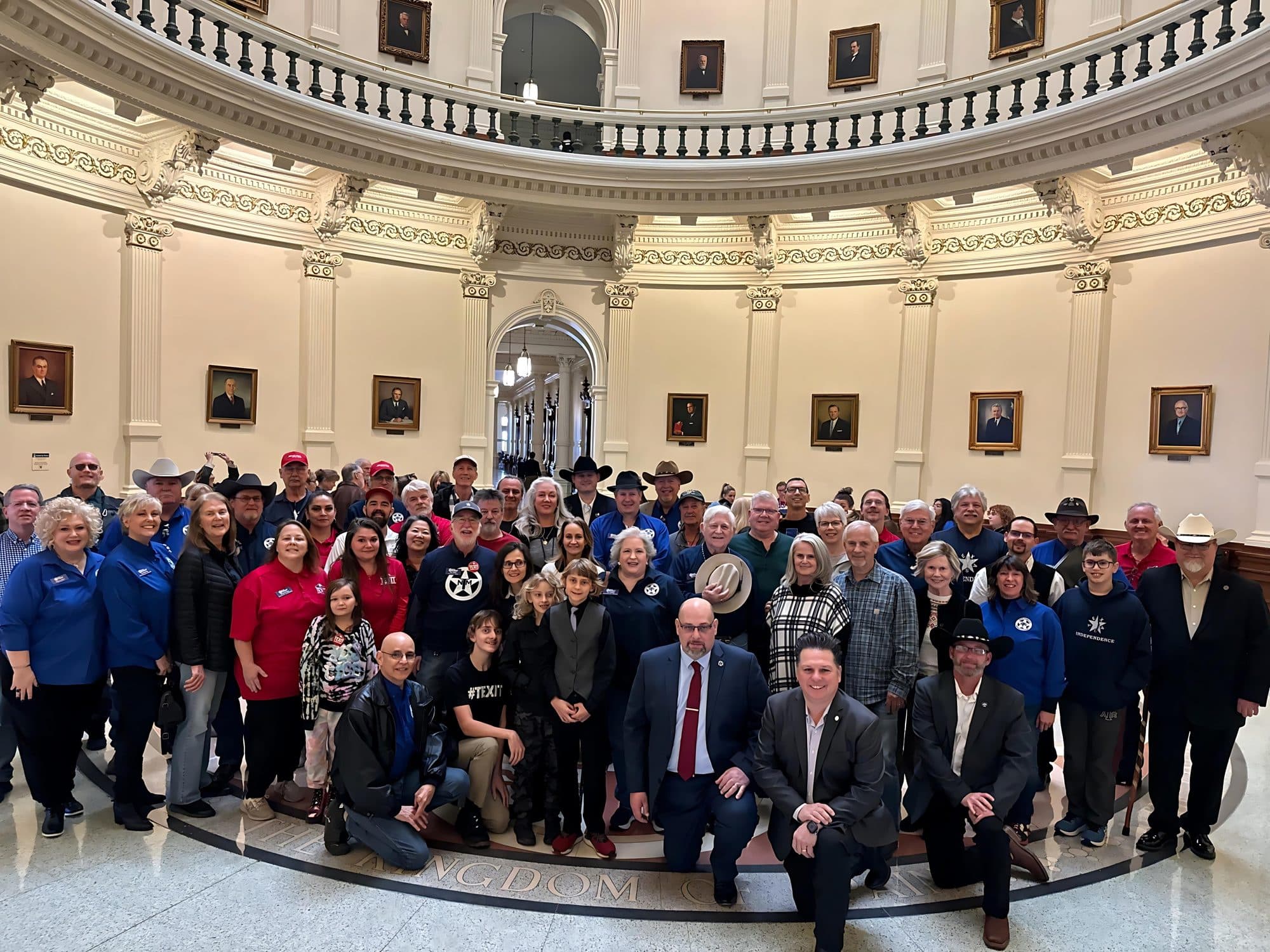
Whose consent is the whole question.
The Texas Capitol rotunda
The hard questions
Every objection, answered.
The questions below are the ones meant to end the conversation. They do not. Each has a specific, sober answer. Here they are, in turn.
What would Texas use for money?
The same money it used the morning before. Texas can keep the U.S. dollar in circulation on day one, the way Panama, Ecuador, and El Salvador already do, and it needs no one's permission to do it. Roughly a third of the world's countries do not issue their own currency at all. The price of gasoline, the balance in a checking account, and the terms of a mortgage do not change because the flag above the building did.
The paths from there are already being built. Gold and silver are legal tender in Texas under HB 1056, redeemable by debit card against metal held in the state's own Bullion Depository, which is functioning sound-money infrastructure that exists today. Whether Texas keeps the dollar through the transition, spends on that gold-and-silver rail, or later stands up its own central bank and currency backed by the eighth-largest economy on Earth is a sovereign decision for the government Texans elect, settled from strength rather than locked in today. None of it is a barrier to independence.
Wouldn't Texas still owe its share of the federal debt?
There is no softening the blow. This is the hardest negotiation on the list, and Texas should say so plainly rather than pretend otherwise. But start by calling the thing by its name: the federal debt, not the national debt, borrowed in Washington's name for Washington's spending. When a member leaves a union, the assets and obligations are apportioned by negotiation, not assumed by default. That figure is a negotiation, not a bill.
The precedent is written into the terms Texas joined on. The 1845 annexation agreement had Texas keep its own debts, and Washington insisted in the text that in no event were those debts to become a charge upon the Government of the United States. Each side kept its own books at the start, and each side would keep them again. A departing Texas comes to the table as the eighth-largest economy on Earth, with federal installations, land, and infrastructure sitting on its soil as offsetting assets, and it nets what each side owes the other. Run that reckoning by the methods international law actually recognizes and a good-faith figure can land at zero, because what Washington owes Texans can exceed any share it could assign. What Texas does not do is inherit, unilaterally and without recourse, a per-capita slice of borrowing it never authorized.
How would an independent Texas defend itself?
It would start with more than most nations ever assemble. More than 200,000 Texans already serve in uniform, the defense-industrial base is already here, and the F-35, one of the most capable fighters in the world, is built in Fort Worth. Roughly $72 billion a year in defense activity already runs inside the state, and Texas already has a standing military in the Texas Military Department: an Army and Air National Guard and a State Guard under the governor's command today. The people, the bases, the airframes, and the plants do not relocate because the government changed. Independence is a question of command and continuity, not of building a force from nothing.
It is also why the invasion scenario collapses on contact. An order to turn the United States military on millions of Texans and their elected government is an order more than 200,000 Texans in uniform would refuse to carry out, which is why Washington would not give it. Presence is not the same as union. The United States runs nearly 800 bases in more than 70 countries no one calls part of the Union, and the likely arrangement is the ordinary one between neighbors: a mutual-defense pact with continued joint use of the installations already in Texas, and tariff-free access to the arms Texas itself builds. A Texas that is a willing ally is a stabilizing presence, not a strategic problem for anyone.
Wouldn't leaving wreck the Texas economy?
Texas has been the number one exporting state in the United States for 23 straight years, moving roughly $455 billion in goods a year, more than California and New York combined. It has its own ports, pipelines, power grid, and direct commercial relationships that span the world. Its two-way trade with Mexico alone, already the largest bilateral relationship in the Western Hemisphere, runs past $300 billion a year and simply converts from a U.S.-Mexico arrangement to a Texas-Mexico one, because the goods, the ports, and the supply chains do not move when the flag changes. Goods and capital do not stop crossing a border because the sign above it changed. They cross it under terms, and terms are what sovereign economies negotiate every day. Worst case, Texas adopts the tariff schedule the United States already files with the World Trade Organization and almost no one notices the difference.
An independent Texas would be the eighth-largest economy on Earth on the day it stood up, a $2.77 trillion engine larger than Italy, Canada, Russia, or South Korea. Economies of that scale are not supplicants in trade talks. They set terms.
What happens at the border?
For the first time, Texas would control its own border, set its own immigration and customs policy, and enforce it with its own resources rather than waiting on a federal government that has struggled to do so. That policy would be decided in Austin, by people Texans elect and can hold accountable, not in Washington. Sharing a border with the United States and with Mexico is the arrangement two of the three parties already live under, not a novelty, and more than a million people cross the southern border lawfully every day, most without a passport.
The practical questions, ports of entry, trade lanes, and cross-border movement, are the ordinary business of neighboring states. Both sides have every reason to keep it calm: a peaceful, negotiated separation keeps goods flowing and the border quiet. These matters are managed by agreement, as they are between every pair of bordering nations on the continent. The likely instinct of Texans is to want more control over their own points of entry, not less.
Would any other country actually recognize Texas?
Recognition follows facts, and the facts are hard to ignore: a stable, solvent Texas of tens of millions of people, with a functioning government and the eighth-largest economy on Earth. States recognize other states because it serves their interest to trade, treat, and deal with them, and a self-governing Texas offers all three. The modern law points the same way. The International Court of Justice held in its Kosovo opinion that a declaration of independence violates no rule of international law, and that the principle of territorial integrity is confined to relations between states: it governs how countries treat each other's borders, not a rule that locks a people inside the state they happen to live in. Canada's Supreme Court held in the Quebec Reference that a clear majority creates a binding duty to negotiate in good faith. Washington argued for exactly this reasoning abroad when it suited its interests. If it was lawful for Kosovo, it is lawful for Texas.
Since 1945, more than 140 new self-governing nations have taken their place in the world, most of them smaller, poorer, and less strategically important than Texas would be: an unexceptional precedent, not an exotic one. Recognition is a diplomatic process with a well-worn path, not a veto.
Isn't secession illegal, and didn't the Civil War settle this?
Ask a skeptic to name the law and the conversation arrives, every time, at one 1869 opinion: Texas v. White. It is worth knowing what that case actually was. It was a lawsuit about bonds, and the only question the Court had to decide was whether Texas had standing to sue. It was not even unanimous: Justice Robert Grier dissented on all points raised and decided, unwilling to call a military occupation a state. The sweeping line about an indestructible Union was not necessary to settle who owned the bonds, which makes it dictum, a comment and not a binding holding. Worse for the doctrine, Chief Justice Chase hung that line on the Preamble, and the Court held in 1905, in Jacobson v. Massachusetts, that the Preamble grants the federal government no power at all. The one part of the case that was a true holding, the bond rule, was overruled sixteen years later in Morgan v. United States. The slogan survived only because the question has never been squarely put to the Court again.
Here is the part the talking point skips. That same opinion says the Union can be dissolved through consent of the States. The case waved against independence concedes a lawful, consensual exit inside its own text. It barred a state from leaving unilaterally by force, which is not what a peaceful, negotiated referendum is. And whether a people may govern themselves is a political question, not a judicial one: it belongs to the people of a state, not to nine appointees in Washington. The deeper answer is the one the American founding rests on: governments derive their just powers from the consent of the governed, and consent withdrawn through lawful means is not a crime. The path is narrow, and it is real. It runs through consent and process. Not through violence. Not through rebellion. Through law.
Fine in theory. But is any of this actually realistic?
Realism is a measure of movement, and the movement is measurable. 692,891 Texans across all 254 counties have declared their support for independence, and a poll of likely Texas voters found 66 percent in favor of a vote on the question. That is a majority asking to be allowed to decide, not a fringe. Ideas that begin as unthinkable become debatable, then inevitable, and this one has already made the first two crossings.
Every arrangement that governs us today was once someone's improbable proposal, and none of the people who signed the Declaration of Independence had a spreadsheet. The practical questions on this page all have answers. What remains is whether a self-governing people will decide to do it, not whether it can be done. That is a choice, and choices are made.
Where this goes deeper
I wrote the book on this.
Everything on this page is the short version. The long version is TEXIT: Why and How Texas Will Leave the Union, the first non-fiction book to work through the motivations, the process, and the practicality of a modern Texas exit. It takes each practical question in turn, past theory, and answers it in full.
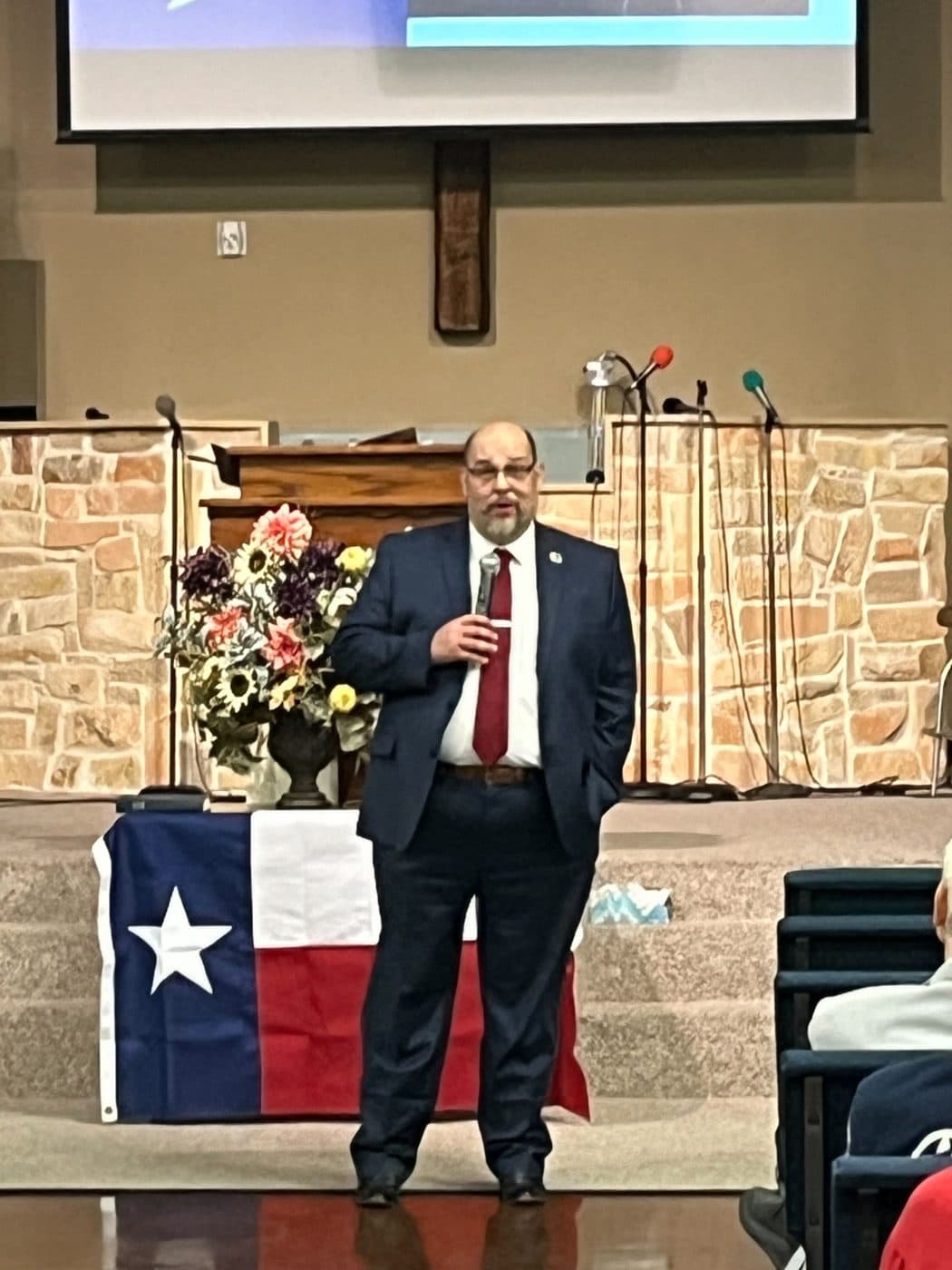
I built this movement, and I made the case for it in print. If the argument here holds, the book is where you test it against every detail.
Get the argument
The full case, direct from Daniel.
Join the list for the complete argument, new writing, and the evidence as it develops. Subscribe and get a free chapter of TEXIT.